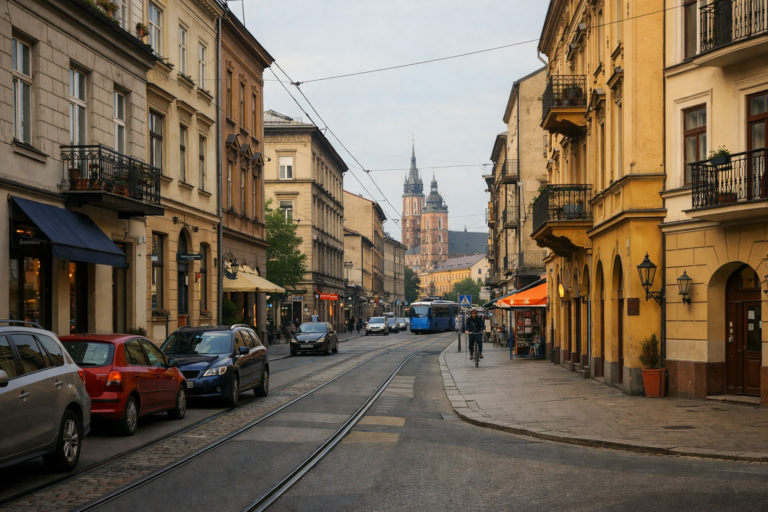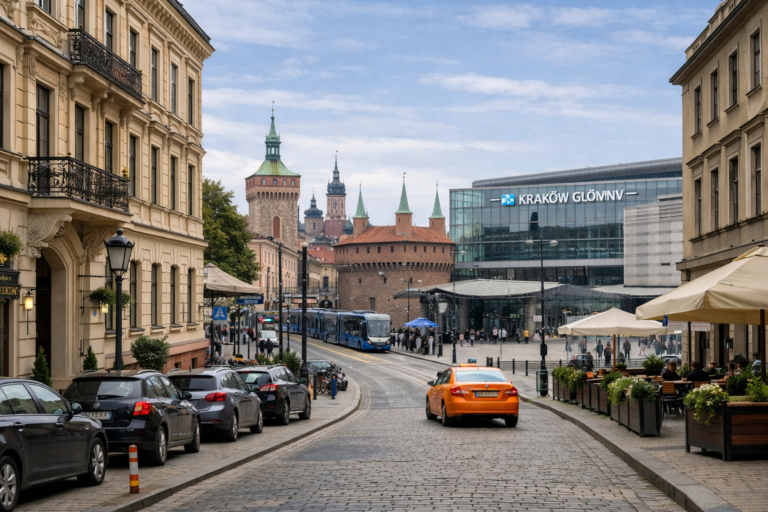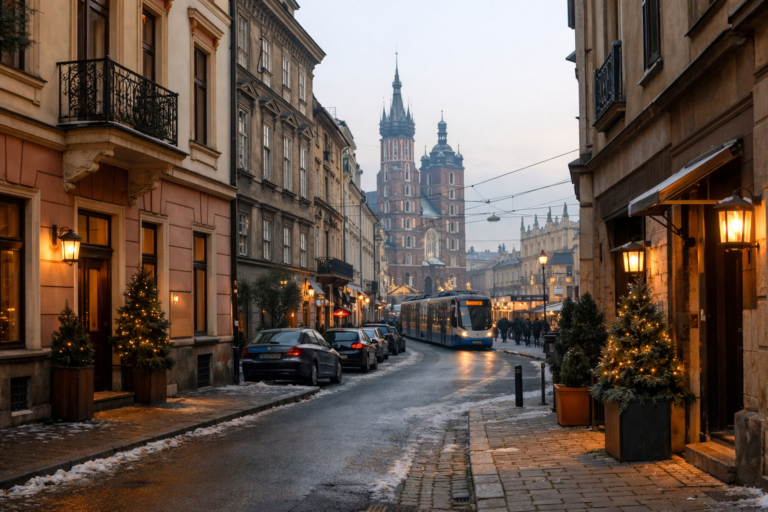
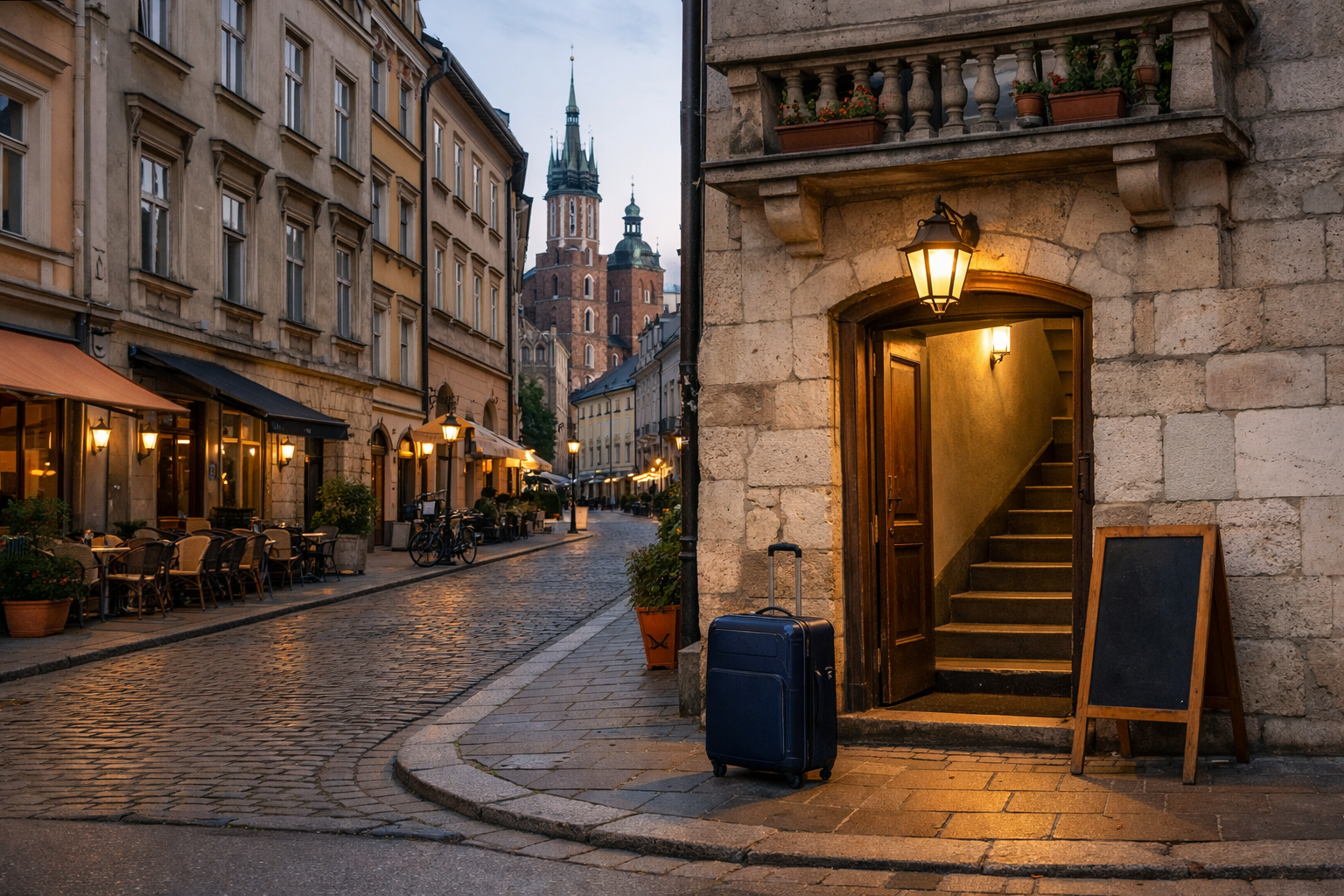
For most solo travellers, the easiest place to stay in Krakow is the historic centre or Kazimierz. Stare Miasto is the simplest choice if you want to walk to the city’s main sights and reduce travel planning. Kazimierz is often the better fit if you want historic surroundings, plenty of nearby places to eat and an evening atmosphere that does not depend on travelling with a group.
Podgórze offers a quieter alternative with its own museums and viewpoints, while the area around Kraków Główny is particularly practical for airport transfers and onward journeys. The right choice depends less on finding the cheapest room and more on how easily you can go out, return after dinner, spend time alone and manage your arrival.
Which area is easiest for a solo trip to Krakow?
For a first visit or a short stay, choose a location that gives you several ways to spend the day without relying on public transport for every outing. A walkable centre is useful when you are travelling alone because it keeps the itinerary flexible: you can return to your accommodation between activities, change plans easily and avoid making every evening a logistical decision.
| Area | Best suited to | Main advantage | What to check before booking |
|---|---|---|---|
| Stare Miasto | First-time visitors and short stays | Immediate access to the main historic sights | The exact street, particularly if you want a quieter night |
| Kazimierz | Solo travellers who want history, food and evening activity | Many independent options within a compact area | How close the accommodation is to the specific streets and stops you will use |
| Podgórze | Visitors seeking a calmer base and cultural attractions | A distinct district with its own history and museums | The route across the Wisła and the evening journey back |
| Kraków Główny area | Airport arrivals and travellers combining Krakow with other destinations | Strong rail and transport connections | The walk from the station or stop to the accommodation |
| Nowa Huta | Visitors focused on modernist and socialist-realist history | A very different urban character from the old centre | The extra travel involved in reaching the historic centre |
Is Stare Miasto the best place to stay alone in Krakow?
Stare Miasto is the safest logistical choice for a short solo visit because it is Krakow’s historic core. The area is enclosed by the Planty park belt and includes the Rynek Główny, routes towards Wawel, St Florian’s Gate and many of the city’s principal museums.
The Main Market Square is also the clearest orientation point in the city. Krakow’s official tourist guide uses it as the reference point for organising attractions by distance, which reflects how useful it is as a base. From this part of town, you can build a day around the square, walk towards Wawel or explore the streets leading towards the river without first working out a tram journey.
This is particularly convenient for a solo traveller who prefers to decide plans as the day develops. You can visit one museum, stop for food, return to your room and go out again without having to cross the city. There are also plenty of public places where being alone feels natural, including cafés, museums, restaurants and busy pedestrian routes.
The important qualification is that Stare Miasto is a broad area rather than one uniform setting. A room near the main square, near the Planty or closer to the station can offer a different experience from one on a narrower street. Before booking, look at the exact address, the route from the nearest stop and whether your room faces a busy street. Centrality is helpful, but it does not automatically mean that every address will suit a light sleeper or someone seeking a low-key evening.
Why is Kazimierz popular with solo travellers?
Kazimierz is the strongest all-round alternative to Stare Miasto for a solo traveller who wants more than sightseeing convenience. It combines historic character with food and evening activity, so there are several ways to spend time outside your accommodation without needing to arrange company.
Kazimierz was once an independent town south of Wawel and the old centre. For centuries it was an important centre of both Jewish and Christian life, before being incorporated into Krakow in 1800. That layered history remains central to the area’s identity. Szeroka Street is associated with the historic Jewish Kazimierz and is home to the Old Synagogue and Remuh Synagogue.
The contemporary visitor area extends beyond one street. The surroundings of Józefa Street, Ciemna Street, Plac Nowy, Miodowa Street and Wolnica, together with the riverside boulevards, create a compact network of places to explore. This gives solo visitors a useful balance: you can spend an afternoon on heritage and museums, choose somewhere informal to eat and continue into the evening without planning a long transfer.
Kazimierz is not simply an entertainment district, however. The character changes from one street to another, and the name “Kazimierz” can describe a wider accommodation area than the historic streets most visitors have in mind. Check the precise location rather than assuming that every property marketed as Kazimierz is equally close to Szeroka, Plac Nowy, Wolnica or the river.
For a first solo trip, Kazimierz works especially well if you value choice without isolation. You can join an organised tour or spend the day independently, and the area still offers obvious places to go when you do not want to eat or sit alone in your room.
Should you stay in Podgórze?
Podgórze is a good option if you want a more distinct neighbourhood base and do not need to be beside the Main Market Square. It lies on the right bank of the Wisła and has its own historic Rynek Podgórski. Formerly an independent town, Podgórze became part of Krakow in 1915.
The district has a strong cultural and historical identity. Relevant places include the Krakus Mound, the Krzemionki area, Cricoteka and MOCAK, as well as Rynek Podgórski. This makes Podgórze appealing to travellers who want to combine museums, urban history and views with a less conventional base than the central old town.
Its main trade-off is geography. Crossing the river is part of the practical calculation, particularly if your plans also include Stare Miasto or if you expect to return late after spending the evening elsewhere. Podgórze is extensive, so the district name alone does not tell you how close an accommodation will be to a bridge, tram stop, museum or restaurant.
When comparing a Podgórze address, check the complete route you would use at night rather than judging it only by the distance shown on a booking map. A location near the places you actually plan to visit may be very convenient; a property on the edge of the district may require more planning than the description suggests.
Compare the next practical option for your trip.
Is the Kraków Główny area practical for a solo traveller?
The area around Kraków Główny railway station is particularly useful if your trip includes an airport arrival, an onward rail journey or an excursion outside Krakow. Kraków Główny is on the SKA1 route connecting Wieliczka Rynek-Kopalnia, Kraków Główny and Kraków Airport.
At the airport, the Kraków Airport railway station is directly beside the terminal and connected by a covered footbridge. The airport also identifies the city bus 300 and night bus 902 as public transport options, alongside the train. These choices make the central railway area a sensible base for travellers who want to keep their arrival and departure straightforward.
For a late arrival, do not assess the area only by its distance from the station. Check the current airport connection, the stop you would use and the walk from that stop to your accommodation. The availability and routing of public transport can change, and the night service should be checked before travelling rather than assumed from an old itinerary.
This area can also suit solo visitors who prefer a practical rather than atmospheric base. It keeps transport decisions simple, but you may need to walk further towards the old centre or Kazimierz for the particular evening setting you want.
How important is night transport when choosing accommodation?
Night transport is useful in Krakow, but it should be treated as a changing part of your plan rather than a permanent guarantee. MPK publishes temporary alterations affecting night routes, including lines 605, 609, 601, 611, 664, 669 and 902. Roadworks can also alter routes and stops in central areas.
The practical question is therefore not simply “Does this district have night buses?” Instead, check four details.
- the nearest stop to the accommodation;
- the stop where you would get off after an evening in another district;
- the current route and any temporary diversion;
- the final walk between the stop and the exact address.
This matters most when choosing between a central address and a cheaper-looking property farther out. A location close to the route you will actually use may be more convenient than one that appears close to the centre but requires a complicated final connection.
What about Grzegórzki or Nowa Huta?
The area around Kraków Główny and Grzegórzki can appeal to travellers who prioritise transport and access to the eastern side of the centre. It is worth assessing by the specific street and stop rather than treating the wider area as one consistent accommodation zone. Temporary changes, including works around Grzegórzecka, can affect the practical value of a nearby connection.
Nowa Huta is a different proposition. It is an important modernist and socialist-realist part of Krakow, with its own history, planned urban layout and attractions. For someone specifically interested in twentieth-century urbanism, it can be a rewarding base or a substantial day’s focus. For a short first visit centred on Stare Miasto, Wawel and Kazimierz, its greater distance adds logistical cost.
Choose Nowa Huta when its character is the reason for your trip, not simply because a listing describes it as part of Krakow. If your priorities are easy independent sightseeing and flexible evenings in the historic centre, a central area will usually require less planning.
How should a solo traveller compare Krakow locations?
Start with your arrival and departure, then consider the shape of your evenings. If you land late, prioritise a clear route from Kraków Airport and a short, understandable final walk. If you plan day trips, the Kraków Główny area gains value. If most of your time will be spent visiting the principal historic sights, Stare Miasto removes the most daily friction.
Choose Kazimierz when you want history, food and several nearby evening options. Choose Podgórze when its museums, river setting and distinctive identity matter more than immediate access to the old centre. Consider Nowa Huta for a deliberately modernist or twentieth-century-focused stay rather than as a default base for a first weekend.
Finally, judge the accommodation by its exact address, not just the district label. Check the nearest stop, the route home after dinner, the distance to the places you expect to use and whether the surrounding streets match the kind of evening you want. For a solo traveller, that small amount of planning often matters more than choosing between two neighbouring areas.