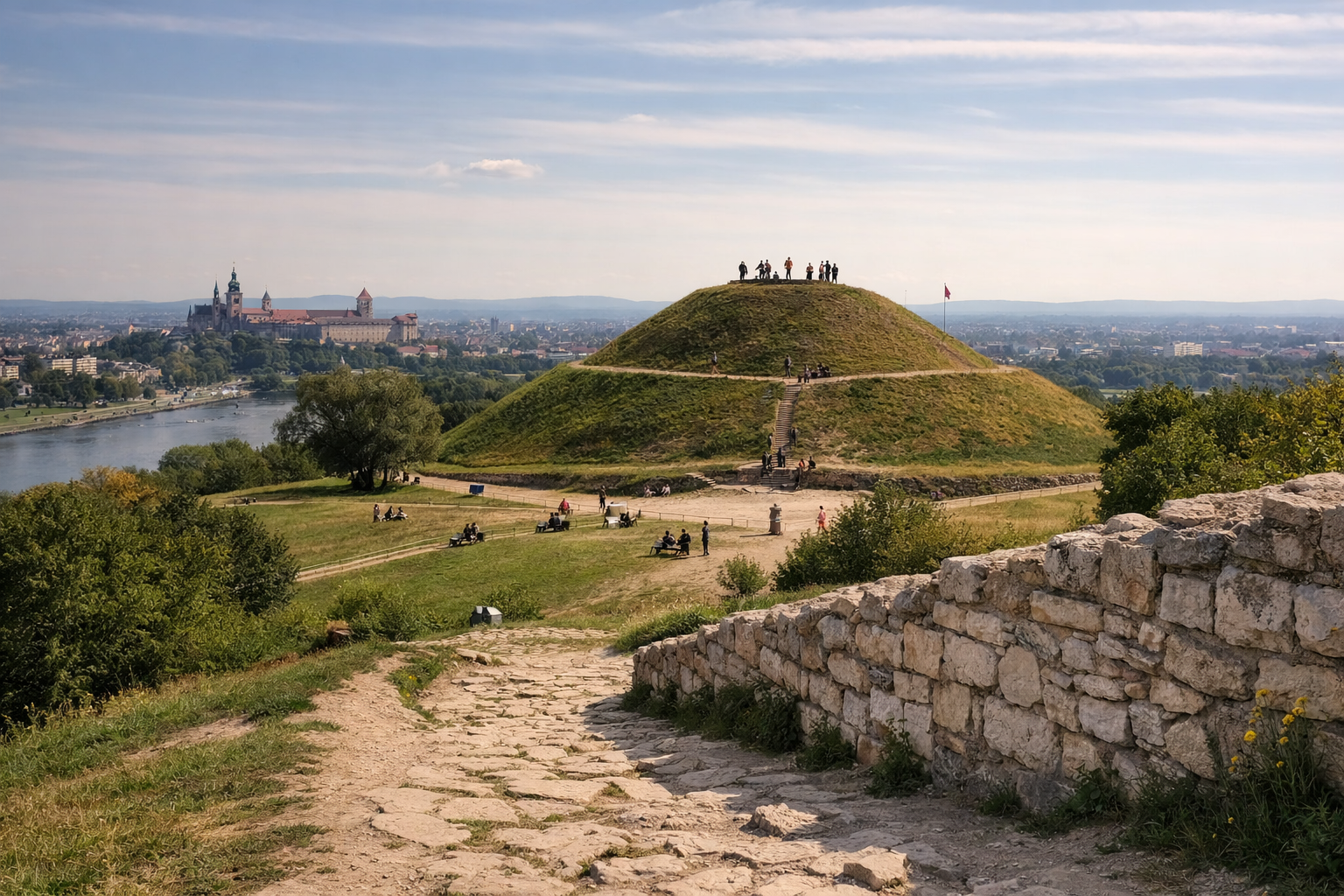
Krakus Mound in Krakow is a free, open-air viewpoint in Podgórze, on Lasota Hill. The mound itself does not require a standard admission ticket or compulsory reservation, and no fixed official opening hours are published for the site. Expect a short but partly steep approach, with some sections that may not be paved. From the top – and also from the meadow below – you can see a broad panorama of Krakow.
The viewpoint is only part of the experience. Krakus Mound stands within one of the most historically layered parts of Podgórze, close to St Benedict’s Church, Fort 31 “St Benedict” and the former Liban Quarry. A visit works best as a flexible walk through the surrounding landscape rather than as a quick stop based only on a photograph from the summit.
Where is Krakus Mound?
Krakus Mound is in Podgórze, on Lasota Hill, in southern Krakow. The city’s description of the approach refers to the area around Rynek Podgórski and the streets Kopiec Krakusa and Franciszka Maryewskiego. From Rynek Podgórski, the mound is a little over 1 km away on foot, making it a realistic addition to a walk through historic Podgórze.
This is not a Stare Miasto attraction and it is not in Kazimierz, even though both areas are relatively close on a city map. The setting feels different: the mound rises above green slopes, old fortification remains and industrial traces, with the built-up city spreading out below.
There is more than one way to approach the site. Because the condition and maintenance of individual paths can vary, it is better to follow the established route you find on arrival rather than treating informal shortcuts across the slopes as recommended access. The final climb is short in overall scale but can be steep in places, and the surface is not necessarily even or paved throughout.
What should you expect at Krakus Mound?
The mound is approximately 16 metres high. It is a grassy historic earthwork rather than a monument with an interior exhibition, ticket desk or visitor centre. The main reward is the elevated position: the summit gives a wide view across Krakow, while the meadow at the foot also provides an open perspective and space to pause.
There are no confirmed fixed opening hours for the mound itself. In practical terms, this means you should not plan around a published daily timetable, but it also does not amount to a formal guarantee of unrestricted access at every hour. Conditions on the ground, weather and any temporary arrangements can affect the visit.
Wear footwear suited to grass, uneven ground and a slope. The site may be simple to visit, but it is not the same as an accessible paved terrace. In wet weather, the approach can feel more demanding, while strong wind or poor visibility can reduce the value of the panorama. There is no need to buy a ticket or make a compulsory reservation for the mound itself.
Is the view from Krakus Mound worth the visit?
For most visitors, the view is the clearest reason to come. The mound offers a broad panorama of Krakow rather than a tightly framed view of one landmark. From the higher ground, the city’s different districts and varied rooflines become part of one landscape. The open meadow below also gives a useful viewpoint, so the experience does not depend entirely on reaching the summit.
Visibility is weather-dependent. A clear day can make the cityscape much more legible, while haze, cloud or rain can flatten the view. It is sensible to treat sunset as a possible atmosphere rather than a guaranteed feature of the visit: the exact quality of the light depends on the season, cloud and visibility.
The panorama is also valuable because of what it reveals about Podgórze. Looking across the district from Lasota Hill, you can understand how historic slopes, former industrial land, defensive structures and modern urban development occupy the same area. The setting gives the viewpoint more context than a standalone photo stop in the centre.
Compare the next practical option for your trip.
What is the story behind Krakus Mound?
Krakus Mound is traditionally associated with Krak, the legendary founder of Krakow. The story connects the mound with the ruler’s burial and with the early origins of the city. That legend remains an important part of the site’s cultural identity, but it should not be presented as a confirmed archaeological fact.
The mound’s precise origin, builders and original purpose are uncertain. The reliable practical facts are its location on Lasota Hill, its approximate height and its long-standing place in Krakow’s landscape and traditions. Keeping the legend and the historical uncertainty separate makes the visit more interesting, not less: the mound represents both a powerful local story and an unresolved historical question.
The site is also associated with the annual Rękawka tradition. A public Rękawka celebration took place at the foot of the mound on 7 April 2026, continuing the connection between the hill, Krakow’s customs and seasonal public events. Such an event does not establish permanent opening hours or guarantee that the same arrangements apply on an ordinary day.
What else can you see near Krakus Mound?
St Benedict’s Church
St Benedict’s Church stands on Lasota Hill near the mound. It is a small historic church and one of the most distinctive landmarks in this part of Podgórze. Its position helps explain why the hill is more than a viewpoint: religious history, local tradition and the defensive landscape are concentrated within a relatively small area.
Access arrangements for the church should be treated separately from the open mound. A visit to Krakus Mound does not automatically mean that the church interior will be open, so avoid making the church the fixed centrepiece of your plan unless you have confirmed the relevant arrangements.
Fort 31 “St Benedict”
Fort 31 “St Benedict” is a surviving element of Krakow’s former fortress system, close to the mound and the church. Its presence adds a military layer to the landscape and helps visitors recognise that the slopes around Lasota Hill were part of the wider defensive system known as the Krakow Fortress.
You can appreciate the fort as part of the surrounding route and landscape. Do not assume that seeing the building from outside means there is a public interior tour or unrestricted entry. The practical value of combining it with the mound is the historical contrast: an ancient-looking earthwork, a historic church and nineteenth-century fortifications occupy the same hillside.
Liban Quarry
From the higher ground, you can look down towards the former Liban Quarry, an industrial and historical site in Podgórze. The quarry is visible from above, but it should not be treated as an ordinary walking destination from Krakus Mound. The available city information indicates that it can be viewed from the mound area, not entered as an open attraction.
This distinction matters. The quarry’s dramatic appearance may invite exploration, but an attractive view is not an invitation to cross barriers or follow unofficial routes. See it as part of the wider panorama and industrial history of Podgórze.
How should you plan a visit to Krakus Mound?
Start from Rynek Podgórski if you want to make the mound part of a broader neighbourhood walk. The distance from the square is a little over 1 km, but the total outing should not be judged only by the map. You may want time for the climb, the panorama, the surrounding historical sites and the uneven terrain.
A straightforward plan is to walk from Rynek Podgórski towards the mound, spend time at both the summit and the meadow below, then continue around Lasota Hill to see the nearby church and fort from the public paths and viewpoints available on the day. The Liban Quarry can be included as a visual stop rather than an attempted destination.
Allow flexibility instead of relying on a precise minute-by-minute itinerary. No single official walking route needs to be treated as the only correct approach, and local path conditions may change. If the ground is wet, choose stable footwear and take care on sloping sections. If visibility is poor, the historical setting can still justify the visit, but the panorama will be less rewarding.
When is Krakus Mound a good choice?
Krakus Mound suits travellers who want a free viewpoint outside the busiest central streets and who are happy with a simple, open-air site rather than a ticketed attraction. It is especially worthwhile for visitors interested in Podgórze’s layered history, because the mound connects naturally with the church, fortifications and quarry landscape.
It is less suitable if you need a fully paved route, a guaranteed indoor programme or a scheduled attraction with published entry times. The mound’s appeal depends on the weather, the condition of the paths and your willingness to explore a historic landscape without a formal visitor itinerary.
In practical terms, bring water if you are combining the mound with a longer walk, protect yourself from changing weather and leave room in your plans for the uneven approach. You do not need a ticket or compulsory reservation for Krakus Mound itself. Go for the broad Krakow panorama, but stay for the way the viewpoint brings together legend, Podgórze’s hills and the remains of the city’s past.