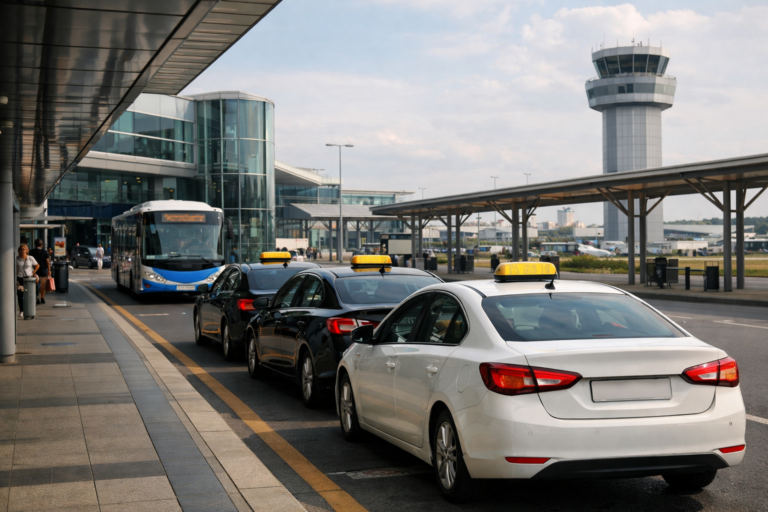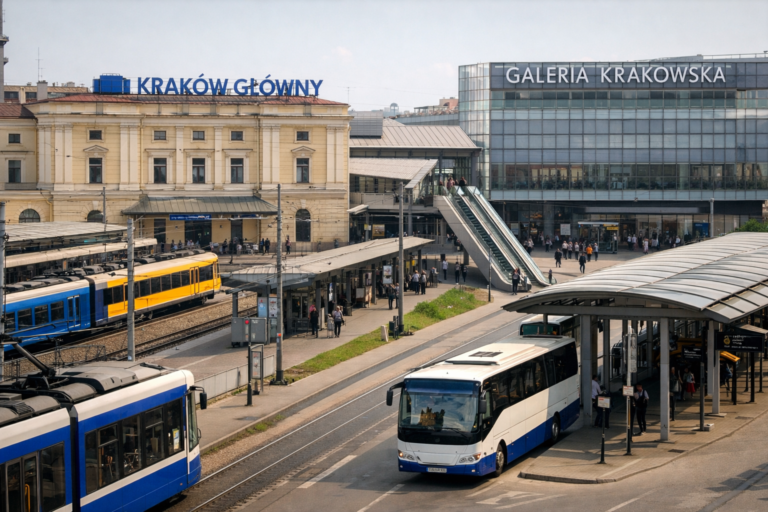
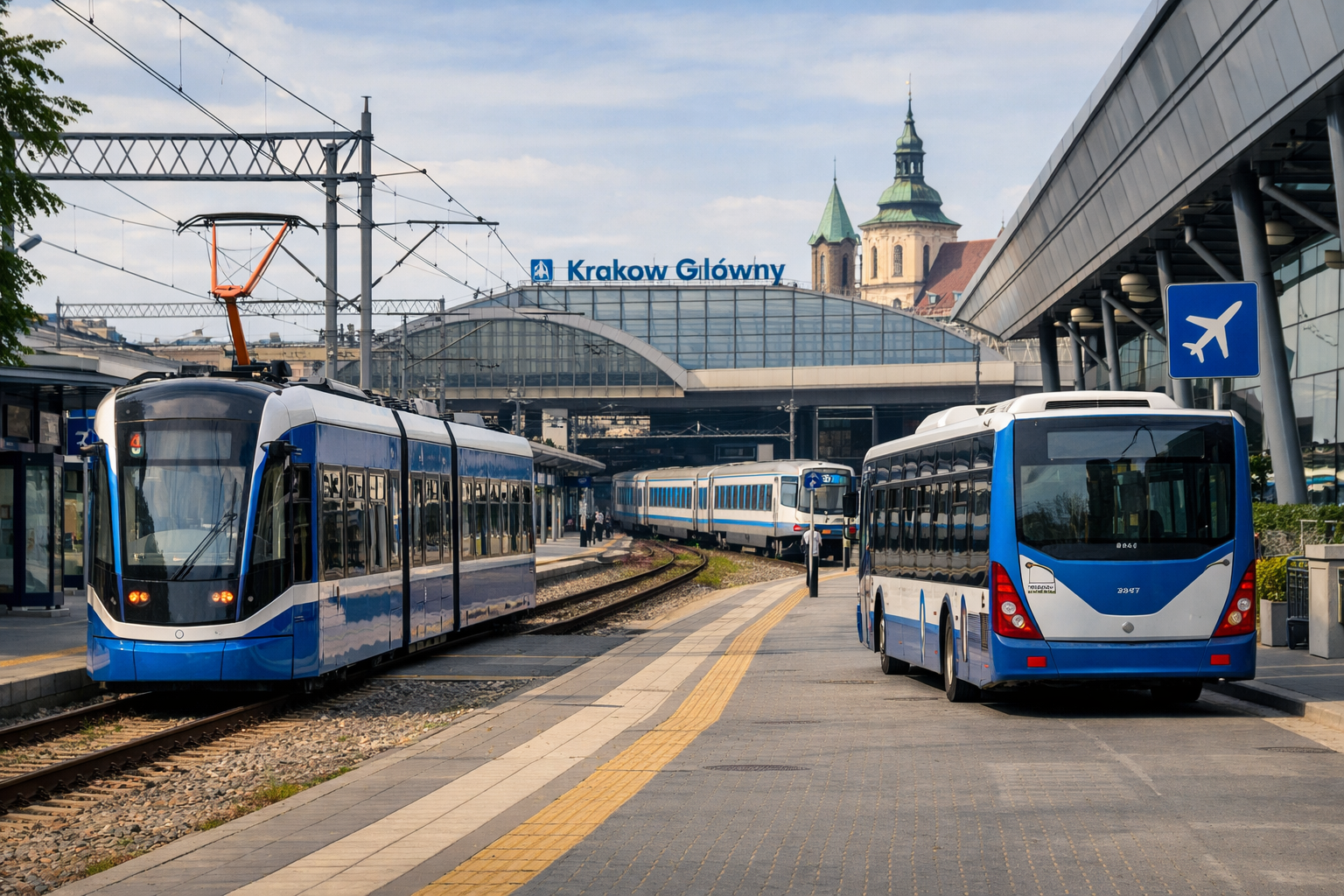
The simple rule is this: if your entire journey stays within Kraków’s administrative boundary, Zone I is normally the relevant public-transport zone. If you travel beyond the city into the surrounding metropolitan area, your ticket must cover every zone used by the complete route. This is why a journey from central Kraków to Kraków Airport needs coverage for Zones I and II, not a Zone I-only ticket.
What do Kraków public-transport Zones I, II and III mean?
Kraków’s transport zones are not simple distance rings drawn around the Old Town. They are based on the administrative and operational area of the Kraków Metropolitan Public Transport network.
Zone I covers the whole municipality of Kraków – the Gmina Miejska Kraków. This includes the historic centre and districts far beyond it. A bus or tram journey within Kraków can therefore remain in Zone I even when it does not take place near the city centre.
Zone II covers selected municipalities next to Kraków. The current tariff includes areas such as Wieliczka, Skawina, Niepołomice, Zabierzów and Zielonki. The exact zone depends on the municipality and the KMK route concerned.
Zone III covers designated outer parts of the KMK network beyond the separately defined Zone I and Zone II areas. You are most likely to encounter it when travelling further into the metropolitan area rather than between Kraków’s central districts and nearby suburbs.
Which ticket do you need for your journey?
The practical test is not “How far from the centre am I?” Instead, ask: does the complete route cross the Kraków city boundary or another tariff-zone boundary? The ticket must remain valid from the boarding stop to the destination, including all zones used along the way.
| Journey type | Zone coverage to look for |
|---|---|
| Travel entirely within Kraków | Zone I |
| Travel from Kraków into a Zone II municipality | Zones I+II |
| Travel from Kraków through outer metropolitan areas in Zone III | All zones used by the route, potentially I+II+III |
| Travel from Kraków to the airport by agglomeration bus | Coverage for the complete route from Zone I into the airport’s Zone II area |
A Zone II-only ticket is not automatically suitable for a journey starting in Kraków, because the first part of that journey is in Zone I. Likewise, a Zone I-only ticket should not be treated as sufficient simply because the destination is marketed as being connected with Kraków.
Is Kraków Airport in Zone I or Zone II?
This means that a journey from the city to the airport normally crosses from Zone I into Zone II. Choose a ticket that covers the full route rather than a product valid only inside Kraków.
The airport’s agglomeration bus connections currently include line 209, line 300 and night line 902. These are not ordinary city-only services confined to Zone I. The same zone principle applies whether you are travelling towards the airport or from the airport into Kraków: check the coverage for the entire route.
Compare the next practical option for your trip.
Does the airport train use the same zone rule?
The railway connection and the airport buses should not be treated as identical products. The integrated 70-minute KMK-KMŁ ticket has a specific exclusion concerning the Kraków Airport railway station in its rail component. Do not assume that a ticket advertised as combining Kraków public transport with regional rail automatically covers that station.
For an airport bus, focus on the bus route’s zones and select coverage for the complete journey between Kraków and Balice. For a rail journey, check the conditions of the exact integrated ticket, particularly where the airport railway station is concerned.
Why can boundary stops be confusing?
Some stops and network sections near a zone boundary are treated specially in the tariff. Depending on the route and the defined stop or section, a boundary point may be assigned to one zone, the other zone or both. This prevents the map from working like a perfectly exact circle around Kraków.
For most visitors, this technical rule matters only when travelling to a suburban destination close to the boundary. If your route clearly remains inside Kraków, Zone I is the straightforward choice. If it continues to Balice or another municipality outside the city, select the zones used by the complete route instead of relying on the name of the destination.
What should visitors remember before boarding?
- Zone I means the whole municipality of Kraków, not only the Old Town, Kazimierz or the central railway area.
- Kraków Airport in Balice is outside Zone I, so a city-to-airport bus journey needs wider coverage.
- Lines 209, 300 and 902 are agglomeration connections serving the airport.
- A ticket valid only in Zone II is not enough for a journey that starts in Kraków’s Zone I.
- Transport tariff zones are different from Kraków’s paid-parking zones.
When in doubt, identify the starting point, destination and complete route first. Then choose a ticket covering every public-transport zone crossed between them.