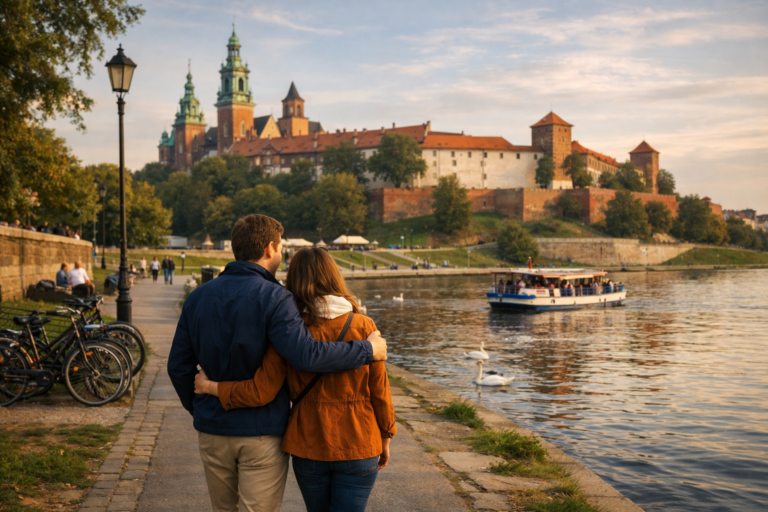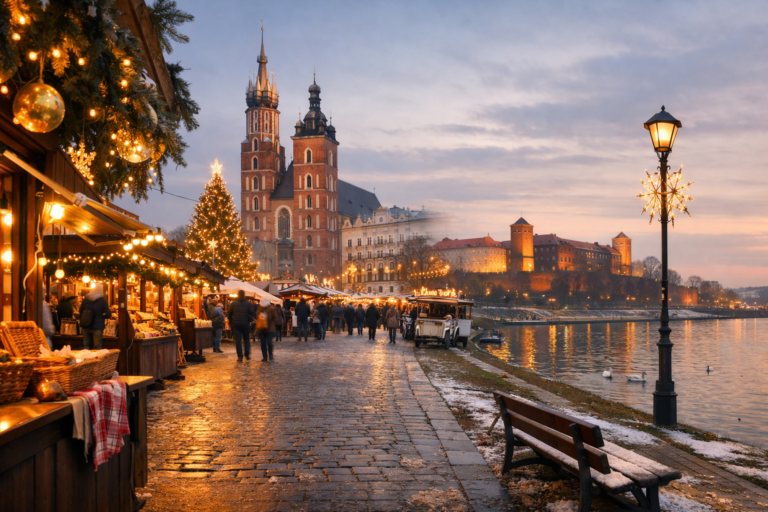
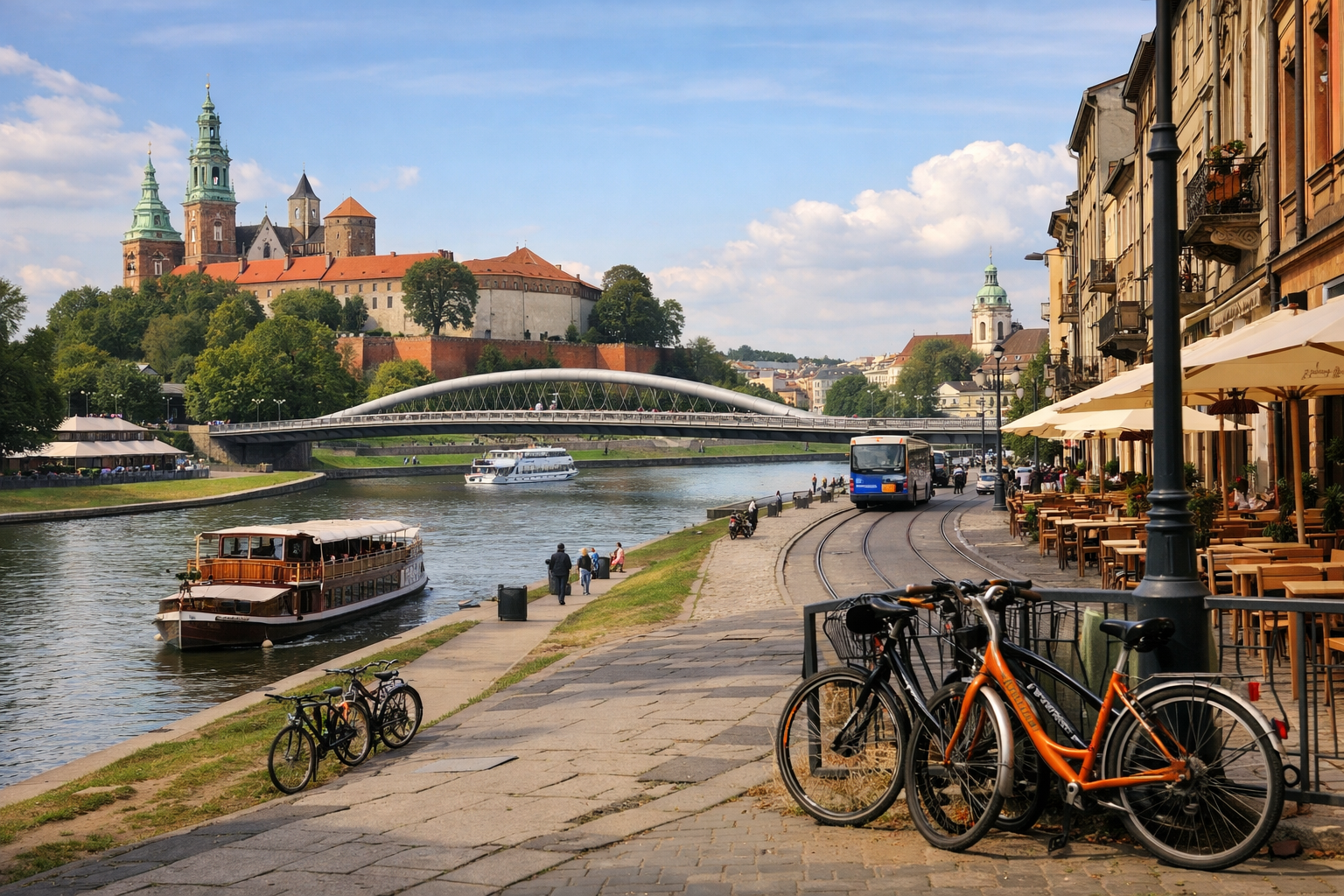
A good krakow 4 day itinerary should not spend all four days around the Old Town. Krakow’s centre is compact, but the city’s history and character are spread across several distinct areas. The most balanced plan is to combine the Old Town and Wawel on day one, Kazimierz and Podgórze on day two, reserve day three for an optional visit to Auschwitz-Birkenau, and use day four for Nowa Huta.
This area-based approach gives you a clear route each day, while leaving enough flexibility for museums, cafés, churches, riverside walks and unplanned stops. It also avoids treating an out-of-city memorial visit as though it were simply another Krakow attraction.
Day 1: Old Town and Wawel in one historical route
Begin with Krakow’s central historical area around the Main Market Square, then follow the route south towards Wawel Hill. These sights belong together geographically: Wawel Royal Castle is in the Old Town at Wawel 5, 31-001 Kraków, and is about a 10-minute walk from the Main Market Square.
Use the morning for the Main Market Square and the streets immediately around it. This is the best day for seeing Krakow’s most recognisable central landmarks without repeatedly crossing the city. Continue towards Wawel via Grodzka or Kanonicza, allowing time to explore the hill and select the parts of the castle complex that interest you most.
What to plan at Wawel
Wawel Royal Castle is not one single undifferentiated exhibition. Its visitor experience includes separate areas and exhibitions, so check the available options before choosing a ticket. The castle applies daily entrance limits, and visitors must follow the entrance time printed on their ticket. Online tickets are available approximately one month in advance according to the current visitor information.
This makes Wawel the part of the day that benefits most from advance planning. Keep the rest of the Old Town route flexible, but avoid treating the castle as a casual stop if you want to see a particular interior.
Where does Rynek Underground fit?
Rynek Underground, at Rynek Główny 1, 31-042 Kraków, is directly beneath the Main Market Square, so it works naturally at the beginning or end of your central day. The museum presents Krakow’s history through the archaeological remains and objects found beneath the square, making it a useful complement to the streets above.
Its opening hours vary by weekday, it is closed on the second Monday of the month, and last admission is 75 minutes before closing. Check the calendar before assigning it to a particular day. If your chosen day does not work, the surrounding square and Wawel route can still be completed without it.
Day 2: Kazimierz, the Vistula and Podgórze
Use the second day to explore the connected corridor from Kazimierz to Podgórze. Kazimierz is Krakow’s historic Jewish district, while Podgórze developed as a separate city on the south bank of the Vistula. They are adjacent central areas, but they offer a noticeably different experience from the medieval Old Town.
Start in Kazimierz, where the historic Jewish quarter provides the context for the day. Rather than trying to visit every possible attraction, allow time to move through the district at a measured pace before crossing the Vistula towards Podgórze. The route is best understood as a sequence of connected areas, not as one large museum complex.
Follow the Memory Trail as separate stops
The Museum of Krakow’s Memory Trail links three separate branches concerned with Krakow in 1939-1945-1956: Ulica Pomorska, Fabryka Emalia Oskara Schindlera and Apteka pod Orłem. The trail is thematically connected, but the institutions are in different locations, so plan them as individual visits rather than expecting one continuous building.
Two particularly useful Podgórze stops are.
- Apteka pod Orłem, plac Bohaterów Getta 18, 30-547 Kraków. It is located by the former ghetto square and is one of the Museum of Krakow’s Memory Trail branches. The current listing gives opening from Wednesday to Sunday, 9:00 to 17:00, with free admission on Wednesday.
- Fabryka Emalia Oskara Schindlera, ul. Lipowa 4, 30-702 Kraków. This is another Memory Trail branch, focused on Krakow under German occupation and the wartime history associated with the former factory. Individual tickets can be bought online up to 90 days before the visit, and online individual-ticket holders must bring an original identity document.
You do not have to visit all three Memory Trail branches in one day. If you choose two, use the remaining time for Podgórze’s streets, the Vistula-side area and a slower transition back towards Kazimierz. The practical advantage of this plan is that it leaves room for the subject matter to be taken seriously rather than turning the day into a race between museum entrances.
Compare the next practical option for your trip.
Day 3: Make Auschwitz-Birkenau a full day outside Krakow
If you want to visit Auschwitz-Birkenau, give it a dedicated day rather than combining it with another Krakow district. The Auschwitz-Birkenau Memorial and Museum is outside Krakow, with the main entrance at ul. Więźniów Oświęcimia 55, Oświęcim.
The memorial consists of two essential parts: Auschwitz I and Auschwitz II-Birkenau. Official visitor guidance recommends allowing at least about 90 minutes for each part and states that visiting both is essential for understanding the site. A standard guided tour lasts about three and a half hours, before taking account of the wider journey and the time needed between the two sections.
What to arrange before travelling
From 1 March 2026, online entry-card reservations are required. Plan to arrive at least 30 minutes before the time on your entry arrangements. This is not a flexible attraction to fit into a spare afternoon, particularly if you want to visit both parts properly.
Keep the day’s expectations realistic. Auschwitz-Birkenau is a significant historical memorial, not a sightseeing stop to be placed between the Main Market Square and dinner. Wear suitable footwear, allow time for the full visit and return to Krakow without adding another major attraction to the same day.
If you decide not to make the out-of-city visit, use this as a spare Krakow day instead. You could extend the Old Town and Kazimierz visits, revisit a museum that required advance booking, or simply keep the day open for the parts of Krakow that you found most interesting.
Day 4: See a different Krakow in Nowa Huta
Finish with Nowa Huta, a separate Krakow district with a very different urban history from the Old Town, Kazimierz and Podgórze. The district is associated with post-war planning and large-scale residential and civic spaces, so it works best as a complete area day rather than as a single isolated attraction.
Start around Plac Centralny to understand the district’s layout, then add one or more cultural stops. The Museum of Krakow has branches in Nowa Huta, including Nowa Huta Museum and Nowa Huta Underground. They are located at os. Szkolne 37 and os. Szkolne 22 respectively. These give the day identifiable historical content beyond simply looking at the urban plan.
The city’s official tourist-guide collection treats Nowa Huta as its own visitor area and includes a dedicated Nowa Huta District Guide as well as a women’s trail. That distinction is useful when planning: this is not a detour from the Old Town but a contrasting part of Krakow with its own stories and routes.
How to pace the final day
Do not overload Nowa Huta with too many separate bookings. Begin with the district’s central spaces, choose the museum branch or branches that match your interests, and leave time to notice the scale and layout of the neighbourhood. This day is particularly valuable after the historic centre because it shows how Krakow changed in the twentieth century.
How should you adjust the four-day plan?
The order above works well for many first-time visitors, but the individual days can be swapped. Put Wawel on the day when your ticket is available, and check Rynek Underground’s calendar before fixing the Old Town schedule. Museum visits on the Memory Trail also require attention to each branch’s separate location and visitor arrangements.
For transport, plan by district rather than memorising a long list of stops. The central days can be organised around walking between connected areas, while Nowa Huta and Auschwitz-Birkenau should be treated as separate travel objectives. Current public-transport lines, fares and journey times can change, so check the network information for your dates instead of relying on a static itinerary.
The result is a four-day Krakow visit with four different emphases: royal and medieval Krakow, wartime history across Kazimierz and Podgórze, a dedicated memorial day outside the city, and the post-war urban story of Nowa Huta. That balance gives you more than a checklist of central attractions while keeping each day geographically and practically manageable.