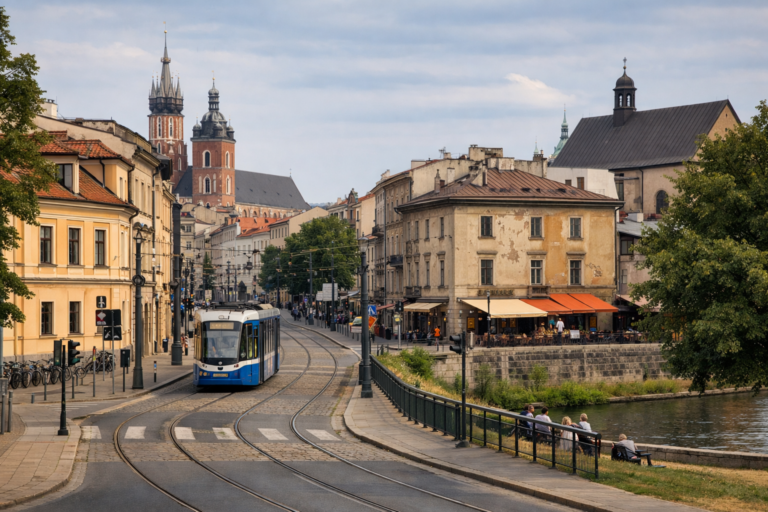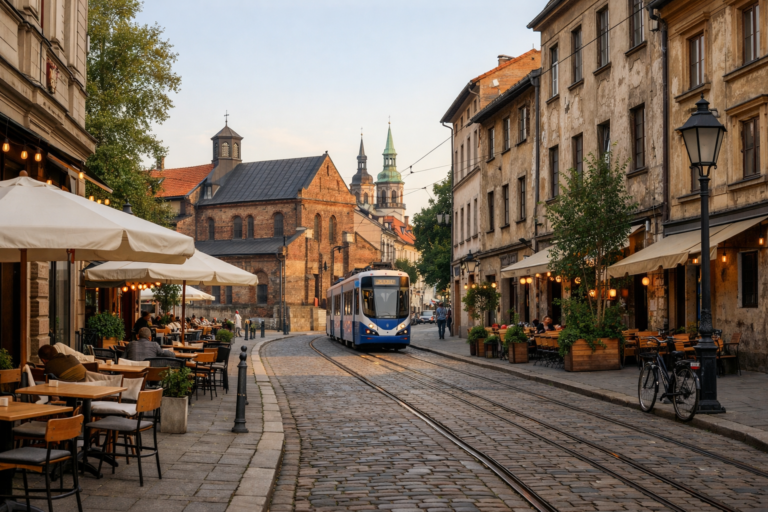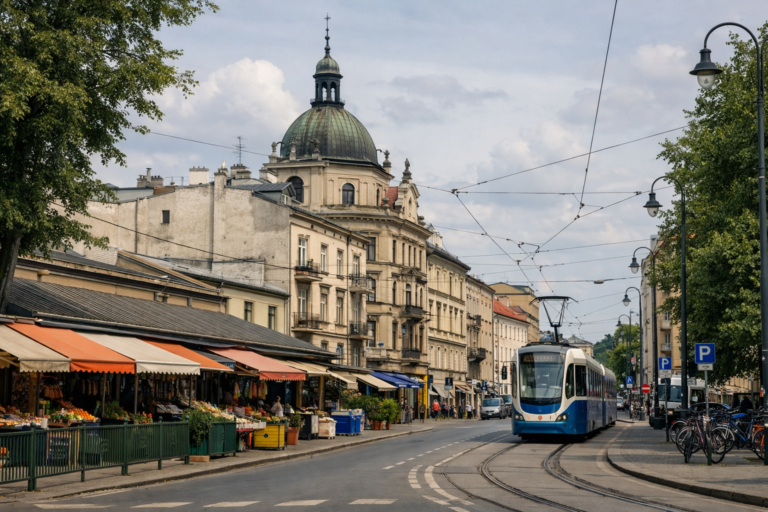
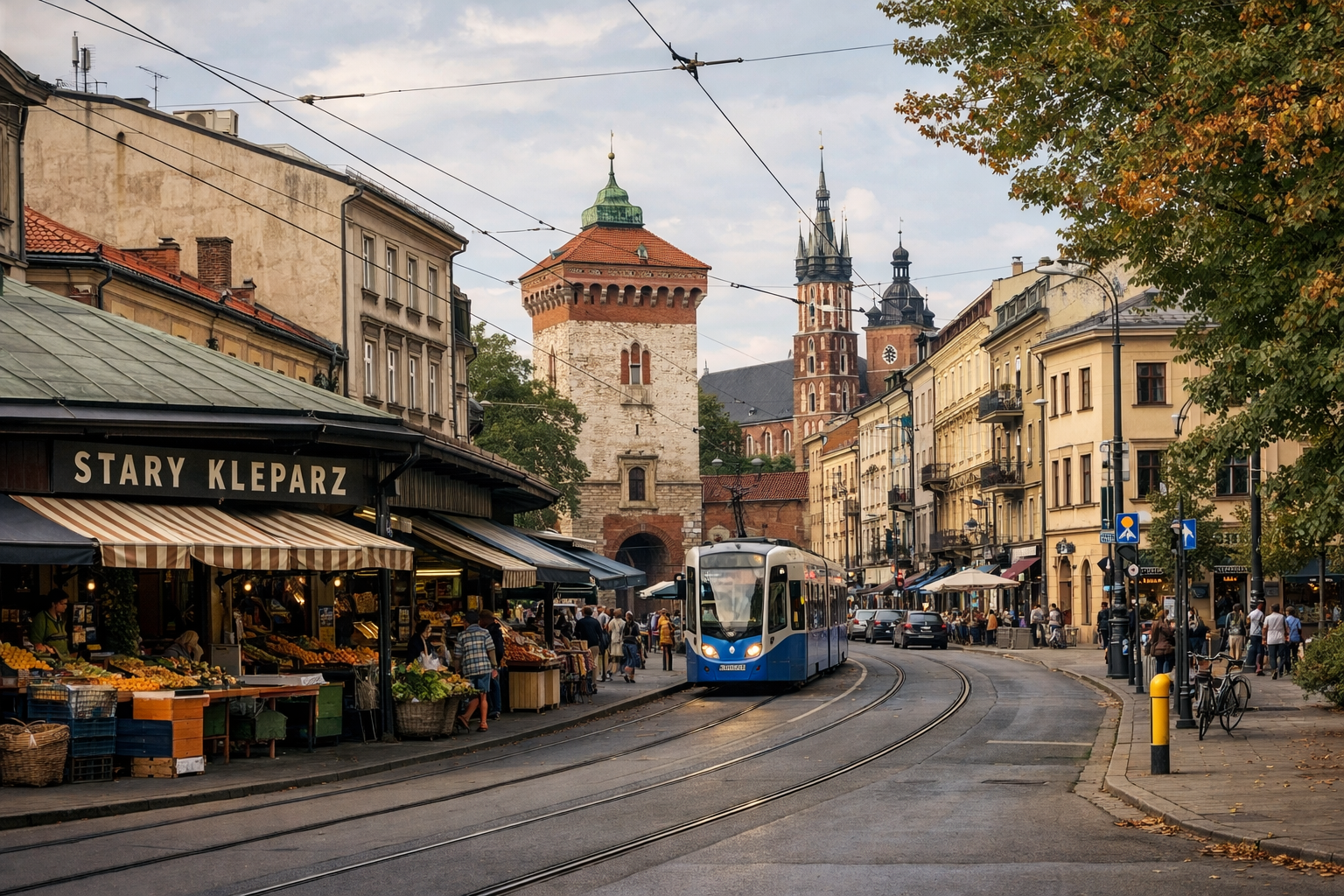
Kleparz and Krakow Old Town are not distant alternatives. Stary Kleparz sits directly beside the northern edge of the Planty ring, so the choice is mainly about atmosphere and daily convenience: Kleparz feels more local and practical, while the Old Town places you inside Krakow’s historic sightseeing area.
For most visitors, the transition is easy to understand on foot or by public transport. Start at Stary Kleparz, Rynek Kleparski, Krakow, follow the northern side of Planty along Basztowa, and you reach the Barbican, St Florian’s Gate and the streets of the Old Town. The areas overlap in everyday travel, but they do not offer the same type of stay.
What is the difference between Kleparz and Krakow Old Town?
Kleparz is the better reference point for local shopping, transport and a less sightseeing-led setting. Krakow Old Town is the historic centre inside the Planty ring, with the main concentration of landmarks, visitor routes, restaurants and traditional central streets.
The word “Kleparz” can mean several related things. It refers to the historic town of Kleparz, the area around Stary Kleparz, a wider contemporary urban area, and the boundary used for planning purposes. These are not identical borders. For a visitor choosing accommodation, the most useful meaning is usually the area around the market and the northern side of the historic centre.
Stary Kleparz occupies the historic area of the former town of Kleparz, whose town charter was issued in 1366. Its present-day identity still comes from trade: it remains a market rather than simply a residential street or a tourist landmark. That gives this side of the centre a more everyday function than the Old Town’s monument-focused streets.
By contrast, Stare Miasto / Old Town is best understood here as the area inside the Planty ring, with its northern edge beside Basztowa. This is a practical visitor definition rather than a claim that every administrative boundary uses exactly the same line.
How does the route from Stary Kleparz to the Old Town work?
The clearest way to understand the geography is as a short urban sequence rather than two separate districts. Stary Kleparz lies to the north. Planty forms the green belt around the historic centre. Basztowa marks the northern side of that belt. The Barbican and St Florian’s Gate then create the most recognisable entrance into the Old Town.
Planty Krakowskie is a park surrounding the Old Town. Its ring follows streets including Westerplatte, św. Gertrudy, Podzamcze, Straszewskiego, Podwale, Dunajewskiego and Basztowa. It covers 20.51 hectares, so it is not merely a narrow strip beside the centre; it is a substantial urban layer between the historic core and the surrounding streets.
The park was laid out between 1822 and 1830 on the site of the former fortification belt. Parts of that defensive system survived, including the Barbican and St Florian’s Gate. This is why the transition from Kleparz to the Old Town has both a practical and historical character: you move from a working market area towards a former fortified city entrance, with Planty marking the change in setting.
For a first orientation, use this sequence.
- Stary Kleparz – the market and the northern transport area.
- Basztowa and Planty – the most useful boundary between the market side and the historic centre.
- Barbican and St Florian’s Gate – preserved parts of the former fortifications and the clearest northern threshold of the Old Town.
- The streets inside Planty – the central Old Town, leading towards the Main Market Square and other major sights.
This makes the comparison straightforward: Kleparz is not “outside Krakow’s centre” in any meaningful visitor sense. It is immediately next to one of the principal approaches to the historic centre.
Which area is better for accommodation?
Choose Kleparz for everyday convenience
Kleparz suits visitors who want to be close to the Old Town without staying in its most intensely sightseeing-oriented setting. The market gives the area a practical, daily-use identity, and the Stary Kleparz transport node connects the surrounding streets around Basztowa, Pawia and Długa.
This can be useful if your trip includes more than the central monuments. You may prefer having a market nearby, a transport interchange close to the accommodation area, and a location that feels connected to ordinary city life as well as tourism. Kleparz is also a sensible base when you want access to the Old Town but do not need your front door to be on one of the central sightseeing streets.
However, “Kleparz” should not be treated as one precisely bounded neighbourhood. Accommodation listings can use the name loosely, so check the actual street and its position in relation to Stary Kleparz, Basztowa and Planty rather than relying only on the label.
Choose the Old Town for immediate sightseeing access
The Old Town is the simpler choice when your priority is to spend much of the visit among Krakow’s principal historic spaces. Staying inside the Planty ring places you within the area most visitors associate with the city centre, with St Florian’s Gate providing a particularly clear northern entrance.
The trade-off is one of character rather than distance. The Old Town is organised around historic streets, attractions and visitor activity. Kleparz has a stronger market and transport identity. Neither area is automatically better: the right choice depends on whether you value being surrounded by the sightseeing core or being beside it while retaining a more practical neighbourhood setting.
Compare the next practical option for your trip.
What is Stary Kleparz like compared with the Old Town?
Stary Kleparz is a historic market with a commercial role inherited from the former market of Kleparz. Its importance is therefore functional as well as historical. It is a place associated with shopping and movement through the northern centre, not simply a photo stop on a monument route.
The Old Town offers a different kind of urban experience. Its significance comes from the preserved historic centre within Planty and the concentration of Krakow’s best-known landmarks. The Barbican and St Florian’s Gate are especially useful for understanding the change between the two areas: they are historic structures at the edge of the tourist core, while Stary Kleparz represents the market and transport side just beyond it.
In practical terms, someone staying near Stary Kleparz can combine both experiences easily. You can use the market area as your local reference point, enter the Old Town through the northern fortifications, and then continue towards the central squares and streets. Someone staying inside the Old Town can make the reverse journey for the market atmosphere without travelling to a distant district.
How useful is public transport from Kleparz?
The named stop Stary Kleparz is a multi-platform public-transport node with positions around Basztowa, Pawia and Długa. It has tram and bus-tram services, which explains why the area is practical for journeys beyond the immediate Old Town.
Do not assume that a normal tram journey will always operate in the same way. The tram section between Stary Kleparz and Teatr Bagatela is currently affected by works at the Teatr Bagatela interchange, so routes and replacement arrangements can change. Check the current Krakow public-transport information before relying on a particular tram connection.
For short journeys into the Old Town, the geography matters more than memorising a route number. The Old Town begins in practical terms on the other side of the Planty and Basztowa edge, while Stary Kleparz is the northern-side interchange. Public transport is most valuable when travelling further across Krakow; for the central comparison, the direct relationship between the two areas is the key fact.
Does the formal Kleparz boundary matter to visitors?
Usually, no – but it explains why maps and accommodation descriptions can appear inconsistent. The local planning area called “Kleparz” covers 78 hectares and includes land in District I Stare Miasto and District V Krowodrza. It has therefore crossed administrative district boundaries in planning terms.
This does not mean that the whole planning area has one uniform atmosphere or that it matches the historic town exactly. For visitors, the useful distinction is simpler: look at the location relative to Stary Kleparz, Planty and Basztowa, then consider whether the address feels more like a market and transport area or more like the historic centre.
Which should you choose: Kleparz or Old Town?
Choose Kleparz if you want a practical base near a historic market, a major transport node and the northern edge of the centre. It is particularly suitable for visitors who like having an everyday city setting alongside easy access to the main attractions.
Choose Old Town if your main priority is to step straight into Krakow’s historic core, with Planty, St Florian’s Gate and the central sightseeing area immediately around you. It is the more direct choice for a first visit built around landmarks and central walking routes.
If you are undecided, the most useful compromise is to search the corridor from Stary Kleparz to Basztowa. This places you close to both identities: the market and transport facilities of Kleparz on one side, and Planty, the Barbican, St Florian’s Gate and the Old Town on the other. The difference is therefore less about distance than about which side of the historic boundary you want your accommodation to face.