Grzegórzki Krakow is a practical place to stay if you want to be close to the historic centre without living in the middle of its busiest tourist streets. East of Krakow’s Old Town, the district combines residential streets, everyday services, transport links, the Vistula riverfront and easy access towards Kazimierz and Zabłocie. Its appeal is less about a compact collection of monuments and more about having a well-connected, lived-in base for exploring the city.
The most useful part for visitors is the area around Hala Targowa and the Kraków Grzegórzki railway stop. Further south, the district becomes more closely connected with the Vistula, Galeria Kazimierz and routes towards Zabłocie. Other parts of the administrative district, including areas towards Białucha and the eastern residential streets, feel quieter and less central.
Where are Grzegórzki in Krakow?
Grzegórzki is the official Dzielnica II Grzegórzki, one of Krakow’s administrative districts. Its boundaries include sections near ul. Lubicz, ul. Bosacka, ul. Rakowicka, the Białucha river and the Vistula. It also meets areas associated with the Old Town, Prądnik Czerwony and Podgórze.
That administrative boundary is broader than the area most visitors mean when they search for Grzegórzki Krakow. In practical accommodation terms, the name usually points to the central and southern parts of the district: the streets around Grzegórzecka, Hala Targowa, the railway stop, al. Daszyńskiego and the riverfront.
This distinction matters when choosing an apartment. A property described as being in Grzegórzki may be close to the Old Town and public transport, or it may be in a more residential part of the wider district. Check the precise address rather than relying only on the neighbourhood name.
What is Grzegórzki like for visitors?
Grzegórzki is a mixed residential and service district, not a traditional sightseeing quarter. Much of it is made up of apartment buildings and streets used by local residents. The southern part has more activity connected with the Vistula, shopping and riverfront routes, while the area around the market is one of the district’s most active everyday public spaces.
This gives Grzegórzki a different atmosphere from the Old Town and Kazimierz. You will find shops, transport, local errands and ordinary city life rather than a continuous line of cafés, museums and historic façades. For many international visitors, that is a useful balance: you can reach major sights conveniently, then return to a neighbourhood that feels less dominated by tourism.
Grzegórzki should not be treated as a hidden extension of Kazimierz. Kazimierz is a separate historic district with its own streets, religious heritage and cultural identity. Grzegórzki is closer to a central urban base, with transport infrastructure and practical amenities at its core.
Why is Kraków Grzegórzki station useful?
The Kraków Grzegórzki railway stop opened on 3 September 2023. It stands on the railway viaduct above ul. Grzegórzecka, beside Hala Targowa, and provides a direct local rail option for parts of the city and the wider metropolitan area. The stop has two 200-metre platforms, with access by stairs and lifts.
The station is served by the SKA 1, SKA 2 and SKA 3 regional railway services, together with selected Małopolska Railways connections. Service patterns can change, so check the current journey planner before relying on a particular train or destination. The important practical point is that Grzegórzki is no longer only a tram-and-walking location: it also has a modern railway stop within the neighbourhood.
For visitors, the station’s position is particularly helpful. It is next to the market area and close to routes leading towards the Old Town and Kazimierz. An official transport description gives an approximate walk of around ten minutes from the stop to the Main Market Square and slightly more than five minutes to Kazimierz. These are orientation figures from the station, not guaranteed times from every apartment in Grzegórzki.
Do not confuse Kraków Grzegórzki with Kraków Główny. They are separate railway hubs. Kraków Główny remains the city’s principal mainline station, while Kraków Grzegórzki is a smaller urban stop positioned to serve the eastern central area.
What can you do around Hala Targowa?
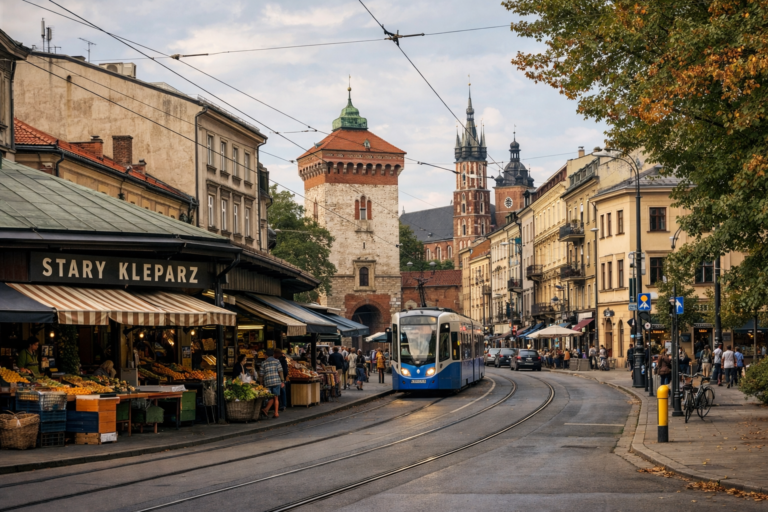
Hala Targowa and the Unitarg market
Hala Targowa and the Unitarg market are at ul. Grzegórzecka 14. The historic municipal market hall was built shortly before the Second World War, while the space beside it developed into an important trading area. Today, the hall and the market should be understood both as historic urban infrastructure and as a continuing everyday marketplace.
This is one of the best places to understand the practical character of Grzegórzki. It is not simply a monument to photograph. The market area functions as a local meeting and shopping space, giving the neighbourhood a stronger daily rhythm than some of the more purely residential streets nearby. The precise selection of stalls and current operating arrangements may vary, so it is sensible to check locally if you are looking for a particular product.
Al. Daszyńskiego
Al. Ignacego Daszyńskiego forms an important green and urban corridor through Grzegórzki. Its layout is associated with the former course of the Old Vistula, which was filled in as the city developed. The avenue is useful for orientation and for understanding how the district connects its residential areas with the market, the river and the central city.
It is not a single sightseeing attraction with a defined entrance or itinerary. Think of it as part of the neighbourhood’s public landscape: a route through a district shaped by old waterways, later urban development and present-day movement between the centre and the Vistula.
How close are the Vistula and Zabłocie?
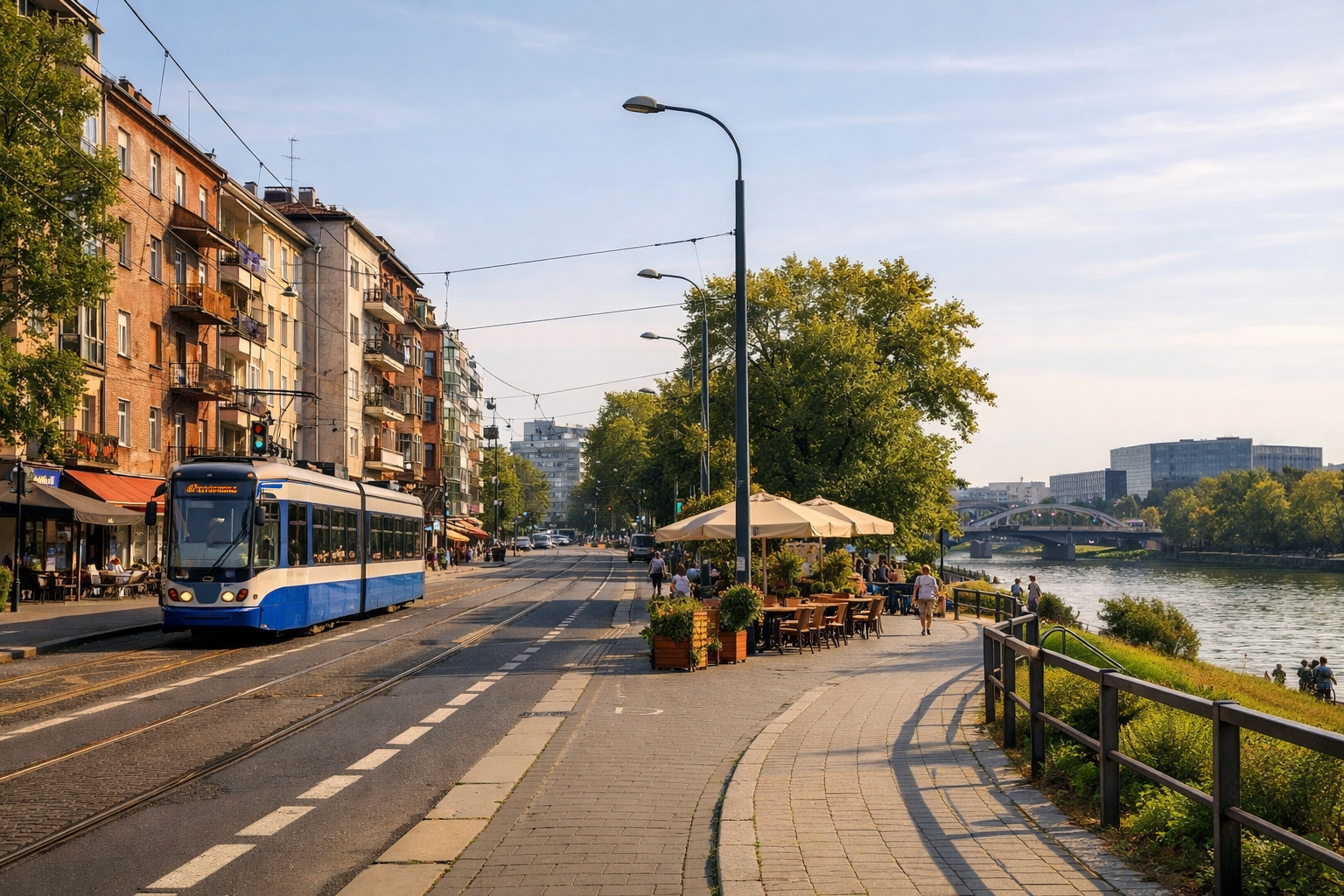
The southern edge of Grzegórzki connects with the Vistula and with routes towards Zabłocie. The existing Grzegórzki-Zabłocie pedestrian and cycling connection improves access from the district to the southern bank of the river and onward to Zabłocie. It is best viewed as a practical cross-district link rather than as a standalone attraction.
This connection makes the neighbourhood more appealing to visitors who want a stay with access to river walks, cycling routes and the changing urban landscape on both sides of the Vistula. It also helps explain why the southern part of Grzegórzki feels different from its quieter inland streets.
Near the river, Galeria Kazimierz at ul. Podgórska 34, 31-536 Kraków, provides contemporary shopping, services, food and entertainment. It is a useful facility for practical needs during a longer stay, especially if you want a supermarket-style shopping environment or indoor services. It is a modern commercial centre, not a historic part of Kazimierz and not a substitute for exploring the district’s older streets.
Park Grzegórzecki, in the area of ul. Grzegórzecka, is another local green reference point. It belongs to the everyday landscape of the district rather than forming a major tourist destination. Plans and proposals for further riverside improvements should be treated separately from what already exists. In particular, a possible riverside park along the Białucha should not be described as a completed, continuous park available for visitors.
Compare the next practical option for your trip.
Which part of Grzegórzki is best for accommodation?
Near Hala Targowa and Kraków Grzegórzki
This is the strongest choice if transport and central access are your priorities. You are close to the railway stop, the market, the Old Town side of the district and routes towards Kazimierz. The area is urban and active, with more traffic and movement than the quieter eastern streets, but it offers the clearest practical advantage for a short city break.
Near al. Daszyńskiego
The Daszyński corridor suits visitors who want a central location with a more residential setting. It provides a useful route towards Hala Targowa and the river, while still keeping the Old Town within easy reach. Apartment quality and street character can vary, so examine the exact block, entrance and nearby roads when comparing properties.
Closer to the Vistula and Galeria Kazimierz
The southern part works well for longer stays and for visitors who value shopping, riverside access and connections towards Zabłocie. It can feel less directly tied to the Old Town than the market area, but it offers a practical mix of commercial facilities and open space. Remember that being near Galeria Kazimierz does not mean that the apartment is in historic Kazimierz.
Further east in the wider district
The eastern and northern sections of Dzielnica II are more residential and may be suitable if you prefer a quieter base. The trade-off is that the neighbourhood name alone tells you less about your access to the railway stop, market and river. For these properties, check the map carefully and consider which entrance, stop or landmark you will use most often.
How does Grzegórzki compare with other central areas?
| Area | Main advantage | Possible trade-off |
|---|---|---|
| Grzegórzki | Central, well connected and practical, with access to the market, railway stop and Vistula | Less concentrated sightseeing and nightlife than the Old Town or Kazimierz |
| Old Town | Immediate access to the Main Market Square and the densest concentration of headline sights | More tourist-focused and potentially busier |
| Kazimierz | Historic streets, cultural landmarks, restaurants and evening activity | Different atmosphere from Grzegórzki and not the same district |
| Zabłocie | Direct access to the southern Vistula side and a former industrial urban landscape | Some addresses are further from the Old Town and central Grzegórzki services |
What should you know about Grzegórzki’s future development?
The Grzegórzki-Centrum local plan area covers 111.02 hectares within Dzielnica II. Planning documents provide a framework for land use and future urban change, but they should not be confused with a completed regeneration programme.
The area around Kraków Grzegórzki station is also part of a longer process of improving interchange conditions, pedestrian movement and the quality of public space. The opening of the railway stop was a clear infrastructure milestone; further changes around it should be understood as ongoing city development rather than as a finished redevelopment project.
The same caution applies to the Białucha. Existing streets, parks, riverfront routes and the Grzegórzki-Zabłocie connection are separate elements. A proposed or requested riverside park along the Białucha is not the same as an already completed visitor attraction.
Is Grzegórzki a good base for a Krakow stay?
For most visitors, the answer is yes if you want central convenience without a fully tourist-oriented setting. Grzegórzki offers a useful combination of local services, the Hala Targowa market area, Kraków Grzegórzki railway stop, access towards the Old Town and Kazimierz, and a practical route to the Vistula and Zabłocie.
Choose it for transport, everyday shopping and flexibility rather than for a postcard-perfect historic atmosphere. When booking, compare the exact address, its distance from the railway stop or river, and the character of the immediate street. The wider district is varied, but its central and southern parts can make an especially effective base for exploring Krakow.